This article is an English translation of the original Japanese article based on firsthand experience.(この記事は日本語記事の翻訳です。)
You can read the original Japanese version here(オリジナル記事はこちらら読むことが可能です。):
日本語版はこちら
When you’re at Suzuka Circuit, the question of whether to eat inside the venue or bring your own food doesn’t have a simple answer.
There’s something about circuit food that you can only experience there — but cost and queues are real factors, and bringing your own food often makes more sense than people think.
I’ve been coming to Suzuka for over 15 years, and across more than 20 race weekends including F1 and SUPER GT, I’ve eaten a lot of circuit food. I’ve also brought my own food — including homemade roast beef and roast pork.
Some meals were so good I’d happily eat them again. Others involved long queues and immediate regret. And the food situation at Suzuka has changed quite a bit over the years.
This article is based entirely on those firsthand experiences.
- What is actually worth eating?
- When should you join the queue?
- If you bring your own food, what should you make?
By the end of this article, choosing what to eat at Suzuka should feel a little easier.
For a broader overview of race day — preparation, access, and how to move around — see this guide:
👉 Suzuka Circuit Spectating Guide | Prep, Access, and How to Navigate the Day
- Circuit Food at Suzuka: An Honest Take
- How to Navigate Suzuka’s Food Scene Without Regret
- Category-by-Category: How to Choose Suzuka Circuit Food with Real-Tasting Notes
- How Suzuka’s Food Scene Has Changed in Recent Years
- Circuit Food vs. Bringing Your Own: TKD’s Conclusion
- Further Reading | Making the Most of Your Suzuka Visit
Circuit Food at Suzuka: An Honest Take
After more than 15 years of coming here, my honest opinion is this: it’s something I’d recommend experiencing if you can, but it’s not essential.
There’s genuinely good food — things you wouldn’t normally get to eat — and somehow, food just tastes better at a racing circuit. The non-everyday atmosphere is a big part of it. For me, circuit food is definitely one of the pleasures of watching races in person.
That said, not everything lives up to the wait or the price. Some meals simply don’t clear that bar, and that’s just as true as the rest of it.
In recent years, ingredient costs have pushed prices up, and growing attendance has made the queues noticeably longer.
During F1 weekends, prices are generally higher, and even if you avoid peak lunch hours, waiting more than 30 minutes is not unusual.
In the past, it was easy to say, “Well, it’s circuit pricing,” or “Queues are just part of the experience.”
Recently though, I’ve found myself thinking, “I waited that long for this?” or “At this price… really?” more often than before.
One thing I can say for sure is that your experience with Suzuka’s circuit food depends heavily on what you buy, when you buy it, and where you buy it.
If you just join a random queue, you might end up thinking, “That was expensive for what it was.”
But if you know how to choose, the overall satisfaction goes up a lot.
How to Navigate Suzuka’s Food Scene Without Regret
Most people who come away disappointed with circuit food made the same mistake: they joined whatever queue looked appealing in the moment, without much thought behind it.
The flip side is that a little knowledge goes a long way.
After more than 15 years of eating at this circuit, here are the points that actually improve your chances of finding something worth eating.
What to Look For — and How to Choose
The general principle is to go for things that move quickly and are hard to get badly wrong.
Easy to say, harder to apply in practice.
Even after 15 years, picking a guaranteed winner every time isn’t something I’ve fully cracked.
That said, a few patterns have become clear.
Classic festival food — yakisoba, takoyaki, okonomiyaki and so on — rarely disappoints, but it rarely surprises either. The queues aren’t short, and it doesn’t feel particularly circuit-specific. If you absolutely need a safe option, it’s there. Just don’t expect much more than that.
Curry and ramen follow a similar logic, but there’s often more variation than you’d expect — black curry, regional ramen styles, things you wouldn’t normally find at a fairground. If you want something safe but with a bit more character, these are worth a look.
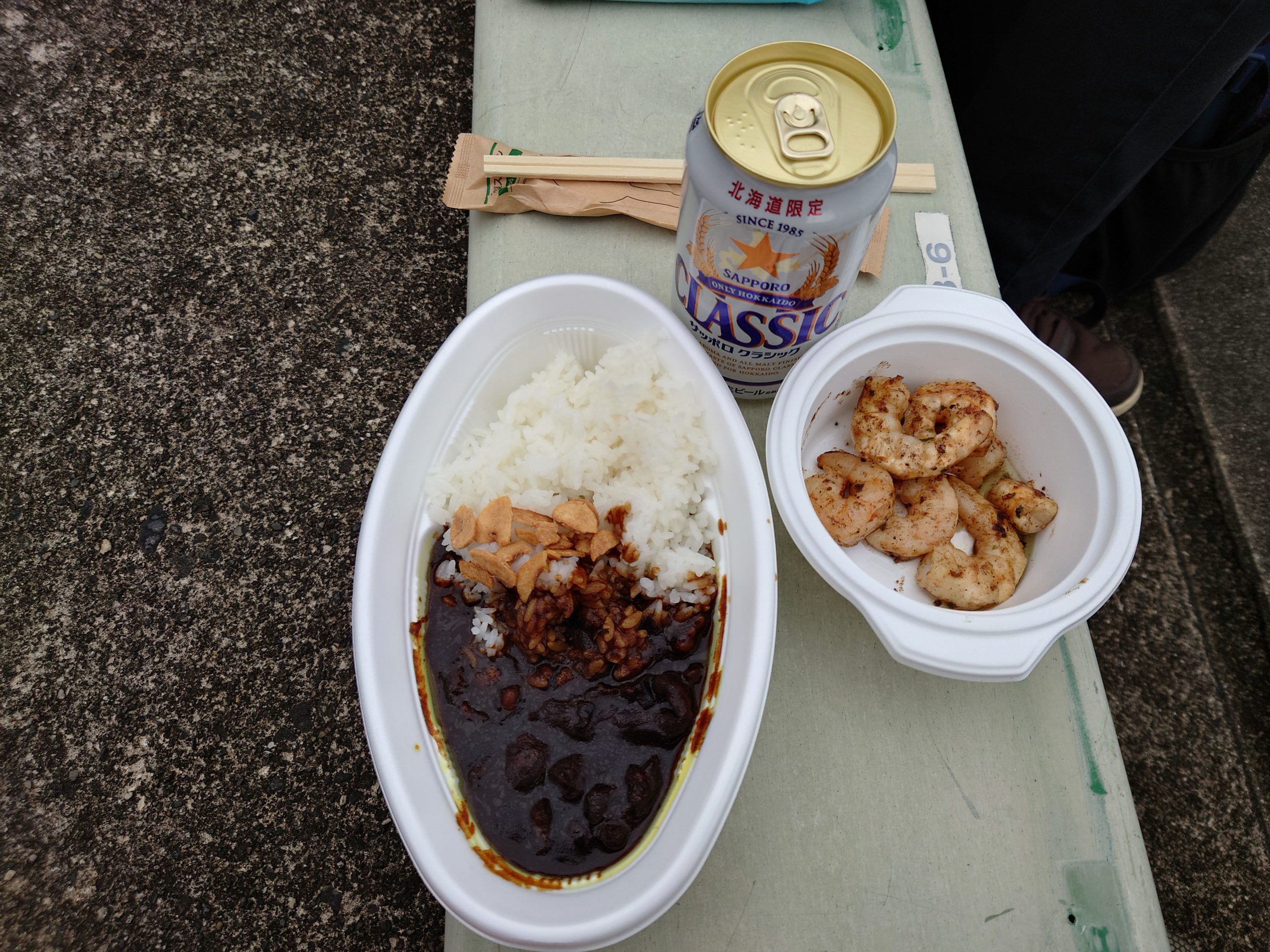
Black curry and garlic shrimp, eaten in 2022. Good value for the price.
Skewers are, in my view, the classic circuit food. They strike a good balance between atmosphere and satisfaction. Recommended for most people, and especially if you’re drinking.
The category I’ve personally come to appreciate most in recent years is the simple, low-cost end of the menu.
More on this below, but some of the best finds in recent years were a dashi-maki skewer at ¥600 for two (at the time) and sliced candied apple at ¥500 (at the time).
This kind of food is often fast, cheap, and genuinely good — and because it doesn’t look flashy, the queues are short. Finding that kind of hidden gem is one of the underrated pleasures of circuit food.
The most important thing, though, is knowing your own priorities.
Is there something you want badly enough to queue for? Or would you rather avoid queues altogether?
Are you happy to join a line during a session while you listen to the cars? Or do you want to be in your seat for every on-track moment?
Once you’re clear on what matters most, the decisions get much easier — and there’s a lot less to regret.
Patterns Worth Avoiding
Starting with the general points:
- A long queue doesn’t mean a good stall | It might just mean a slow one
- Just before sessions is peak queue time | During sessions is often much quieter
- Don’t judge by headline price alone | The gap between price and actual value can be significant
None of this will surprise you, so the explanations will be brief.
Long queues don’t reliably indicate quality. Slow service and under-practised operations are just as common a cause — and often more so.
Queues build before sessions, as everyone wants something to eat while they watch. Sessions run long enough that joining a queue partway through — enjoying the sound while you wait — is a perfectly reasonable trade-off.
Pricing deserves a separate note. Everything is expensive at a circuit, but there’s still a wide range within that. The same kind of dish can vary considerably from stall to stall, and “cheap” doesn’t mean good value, and “expensive” doesn’t mean quality. What matters is whether what you’re getting justifies what you’re paying — judge by what you actually see, not the price tag.
Drinks in particular tend to feel overpriced relative to food, so bringing your own drinks is a reasonable and practical choice.
To close this section, here are my personal rules for getting the most out of circuit food. No guarantees — but these are the habits that have improved my hit rate over the years:
- Stalls in the gaps between viewing areas are worth seeking out | Less traffic, often hidden gems
- Stalls with no queue at all deserve a second look | They might be surprisingly good
- Avoid stalls where the base price feels obviously too high | Possible warning sign
- Go for non-branded beef skewers | Save branded wagyu for yakiniku restaurants
- Bring up to six 350ml cans of beer | Circuit beer prices are not your friend
- Trust your instincts | The obscure menu item is often where the real finds are
If you’re thinking about bringing drinks or snacks, it’s worth considering how that fits with everything else you’re carrying:
👉 Circuit Spectating Packing List | Essentials and Useful Gear for Race Day
How Busy It Gets — and When
The peak is almost always the same: just before and after sessions, overlapping with the lunch window.
Around midday in particular, everything moves at once, and 30-minute queues at popular stalls are the norm rather than the exception.
The three quieter windows are:
- Right after gates open, before the first session | Low crowds, stalls are calm
- During sessions | Most people are watching, food areas thin out
- After the final session, before the exit rush | Some stalls discount or sell out near closing
One caveat for the early window: not all stalls are set up and open right at gate time. Showing up and finding your target stall still preparing is entirely possible.
Location matters as much as timing. The areas around the main straight and Grand Stand are consistently the busiest. The food corners between viewing areas, as mentioned earlier, tend to be noticeably quieter throughout the day.
Crowds can’t be avoided entirely — but being thoughtful about timing and location makes the experience considerably better.
How Things Change Between F1 and SUPER GT
Same circuit, very different food experience depending on which event you’re attending.
The short version: F1 is bigger, more expensive, and more crowded.
On price: F1 weekend runs roughly 10–20% higher than standard circuit pricing. There’s a premium that comes with the event, and it applies almost everywhere. Branded beef skewers priced over ¥2,000 are a common sight.
More stalls come in for F1, but so do more people — the extra supply doesn’t translate into shorter queues.
The selection also shifts. F1 brings in more international-style menus and brands that don’t usually appear at domestic events. That variety is genuinely enjoyable, but those “F1 exclusive” stalls tend to draw the longest lines.
SUPER GT is more manageable on both fronts. Prices are closer to standard circuit levels, and the crowd peaks are easier to read and work around. If food is a big part of your day, SUPER GT is the more relaxed environment for it.
The Suzuka 8 Hours sits somewhere between the two — some of the international atmosphere of F1, without the same level of intensity.
Knowing which event you’re attending and adjusting your approach accordingly is one of the key factors in how well the food side of the day goes.
Category-by-Category: How to Choose Suzuka Circuit Food with Real-Tasting Notes
From here, I’ll go through the food I’ve actually eaten at Suzuka by category.
Ratings use three levels: ◎ (highly recommended), ○ (solid choice), and △ (use caution).
These are, of course, just my personal opinions, but I hope they can still be useful as firsthand tasting notes built on more than 20 visits.
For the official 2026 F1 Japanese GP food information, please check the link below.
👉Suzuka Circuit Official | F1 Recommended Food
Please note that stalls and menus change from year to year, so treat this as a guide to general tendencies rather than a guarantee.
Hearty Meals | ◎ Yakiniku Lunch, △ Roast Beef Bowl / Steak Bowl
If you want something filling while still getting that circuit-food feeling, this is probably the flagship category of Suzuka food.
◎: Yakiniku Lunch
Despite the name, this is basically a simple rice bowl with pork belly and cabbage stir-fried on a hot plate and coated in a special sweet-savory sauce.
The crunchy cabbage, the richness of the pork, and the sauce come together really well.
And at ¥900 (during the 2025 F1 Japanese GP), it’s relatively affordable by circuit-food standards.
I first ate it on the Friday of the 2017 F1 Japanese GP at Spoon Curve, while waiting in the rain for a delayed session to start, and I still remember how impressed I was.
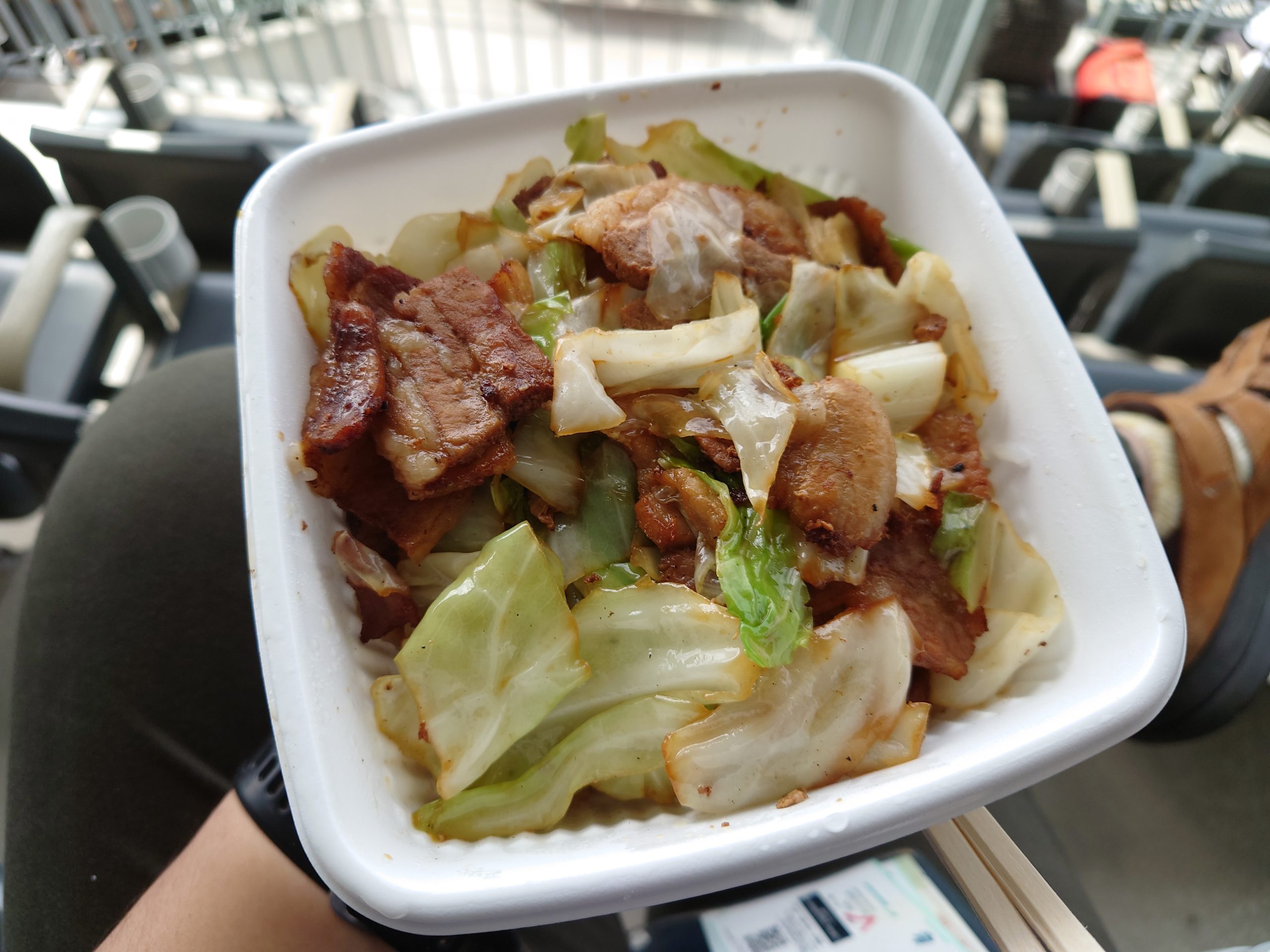
Affordable and delicious Yakiniku Lunch (regular). TKD’s top circuit-food recommendation.
It’s a long-time popular menu item, so you should expect a queue, but I do think it’s worth lining up for.
You can usually get it at the permanent stall near Final Corner and the Chicane (Q Stand area).
△: Roast Beef Bowl / Steak Bowl
At first glance, these sound very appealing.
They look good in photos too, so the ¥1,500 to ¥2,000+ price range can seem understandable.
But honestly, and I say this knowing it may sound harsh, I usually don’t think they’re worth more than ¥1,500.
The meat tends to be thin, the portions small, and the bowls themselves not very filling.
Too often, it feels like the product is relying on the words “roast beef,” “steak,” or sometimes even branded beef to justify the price.
I’m sorry to say it, but that’s been my impression almost every time.
I understand the temptation. I only learned this after trying them myself.
But in my view, it’s smarter to resist that temptation and save your meat appetite for dinner back in Yokkaichi or Nagoya.
Light Bites & B-Grade Classics | ◎ Dashi-Maki Skewer, ○ Bakudan-yaki
I think this category offers the best overall balance of cost performance and satisfaction in Suzuka food.
These are easy to eat between sessions, which probably explains why this category is so popular.
It also changes quickly from year to year.
But that also means it’s one of the easiest places for new surprise hits to appear.
A quick note before I begin: the two items below will probably not be available at the 2026 F1 Japanese GP either.
These are both items I am still personally hoping will come back.
◎: Dashi-Maki Skewer
This was a true “supernova” item — it appeared suddenly in 2023, completely won me over, and then disappeared the following year.
It was a simple dish: dashi-maki tamago on skewers, served in a cup with a Japanese-style sauce.
At around ¥600 for two skewers at the time, it was reasonably priced, and it was just genuinely tasty.
Suzuka food often leans heavily toward rich, oily flavors, so this stood out as something different in a very good way.
It may not have had much “circuit atmosphere,” but it worked equally well as a snack or a light bite, so I think it would have broad appeal.
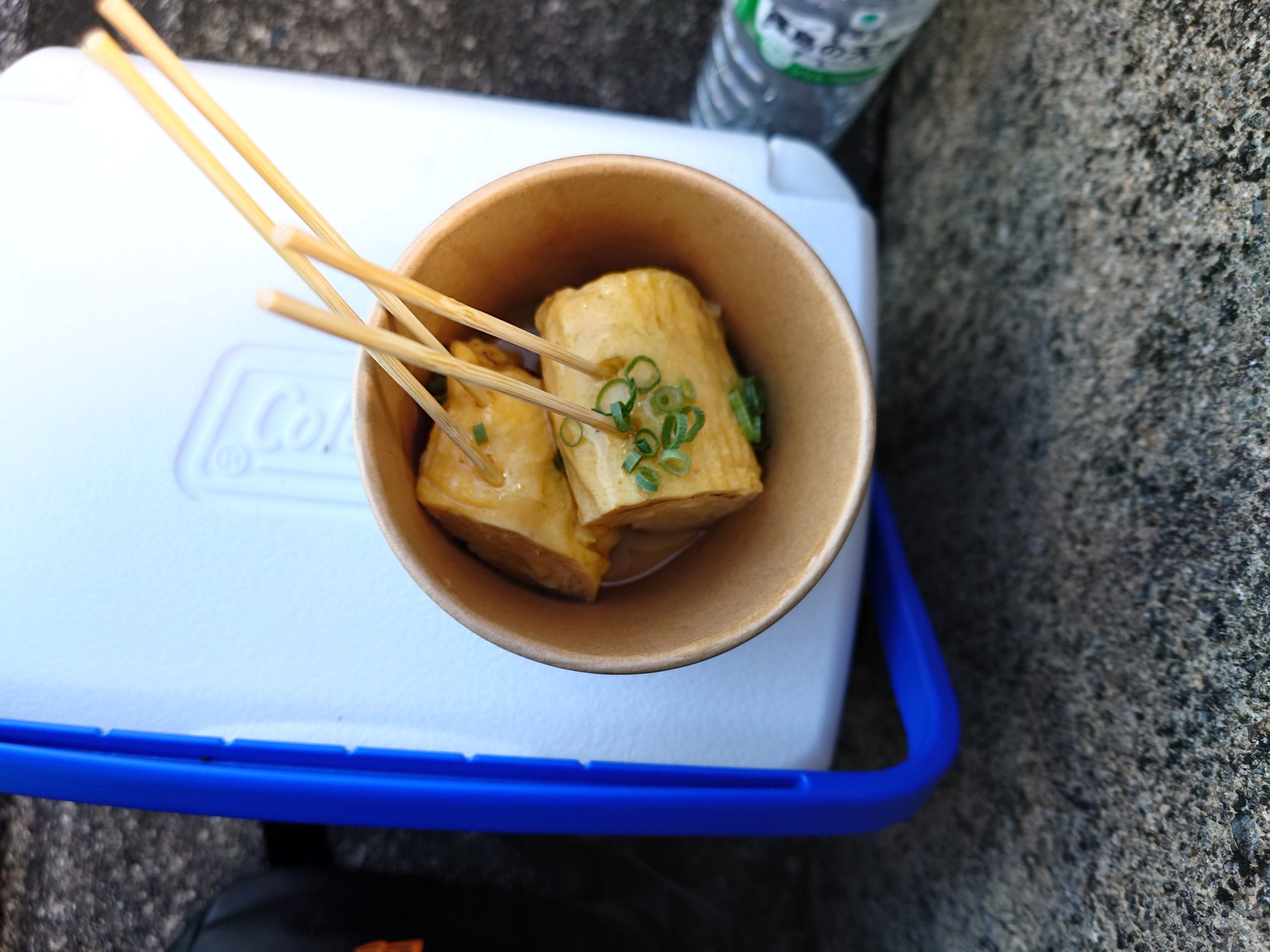
The most surprising find of all. Much better than expected, and worth going back for.
Maybe it just didn’t click with most people, but there was almost never a queue, and I ended up eating it four or five times over that weekend in 2023.
I was quietly hoping to see it again in 2024, but it never showed up.
It’s still the single item I most want to see return.
That stall also sold a bento built around the same dashi-maki at the time.
I had that too, and I would recommend it as well.
If it ever comes back, please try it. Whenever that may be.
○: Bakudan-yaki
The simplest way to describe it is: a giant okonomiyaki disguised as takoyaki.
I used to eat it from time to time around 2017, and I remember it being sold at a permanent stall near C Stand for around ¥700.
It was very filling, and it worked well either as a main meal or something to share with drinks.
It cost a bit more than takoyaki, but considering the volume and satisfaction, it felt fair.
I definitely haven’t seen it in recent years, and it wasn’t listed in the 2026 F1 Japanese GP food information, so I assume it is no longer there.
Still, it’s one of those items I would happily eat again if it returned.
Sweets | ○ Sliced Candied Apple, ○ Candied Strawberry
Sweets at a racing circuit may sound unexpected, but they are actually a category with more demand than you might think.
At some point during the day, you often start wanting something sweet.
In the last few years, I feel like the number of sweet-food stalls has increased, and the options have definitely expanded.
○: Sliced Candied Apple
This is not the whole-apple version, but the easier-to-eat sliced type.
At around ¥500 at the time, it felt relatively reasonable for circuit pricing.
The balance of sweetness and acidity is good, and it’s refreshing enough to eat even after a heavier meal.
It also looks nice, so I think it’s especially good for women or families with children.
Queues are usually short too, so it’s easy to buy without worrying too much about timing.
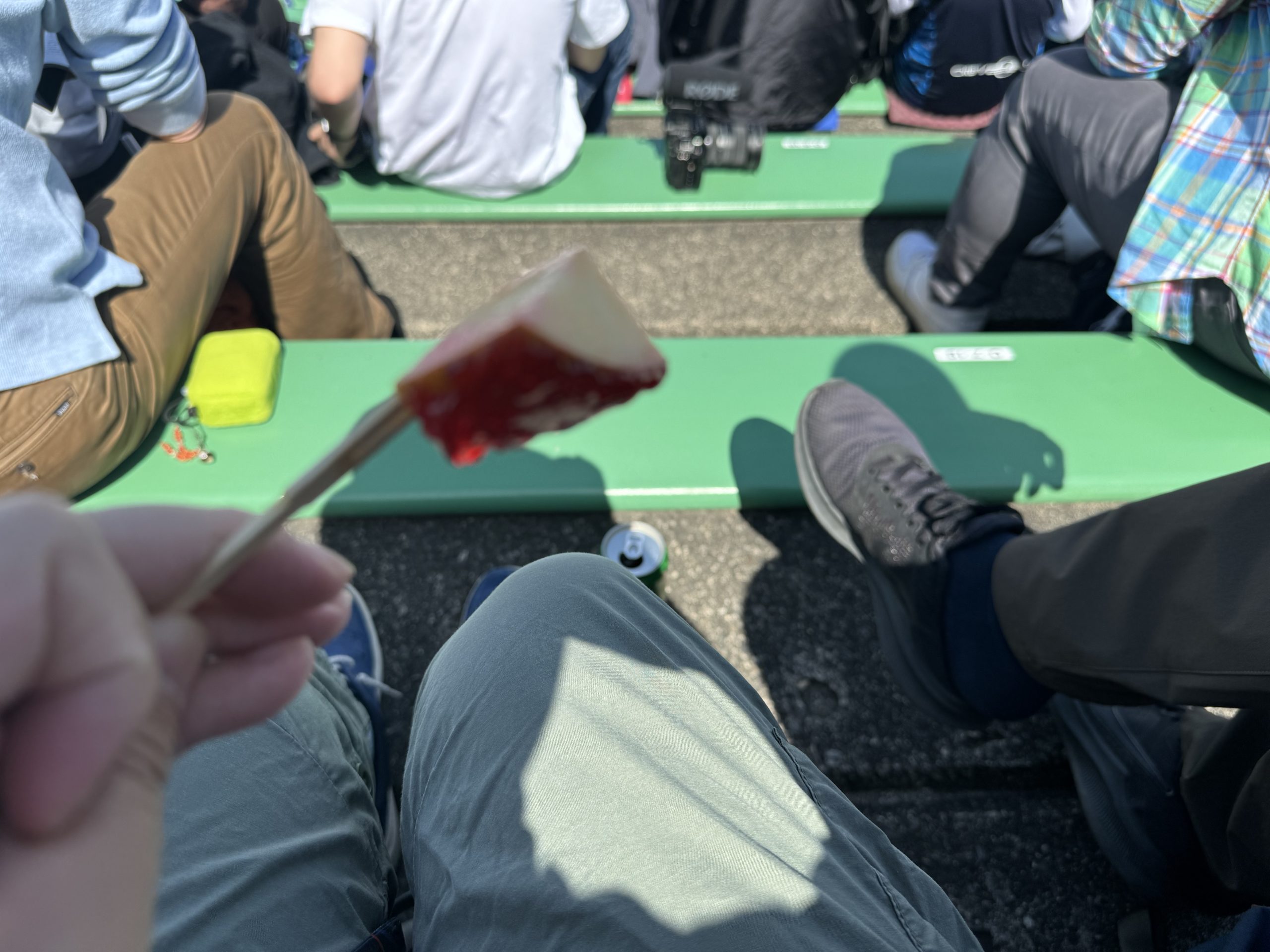
Sliced candied apple. Its simple sweetness pairs surprisingly well with beer too.
○: Candied Strawberry
This is in a similar category to candied apple, but it is usually served on a skewer.
It tends to be a bit more expensive, usually starting from around ¥800.
Because strawberries have a bit of tartness, it’s also easier to eat for people who don’t love very sweet food.
You also often see Shine Muscat versions, or mixed fruit skewers including both.
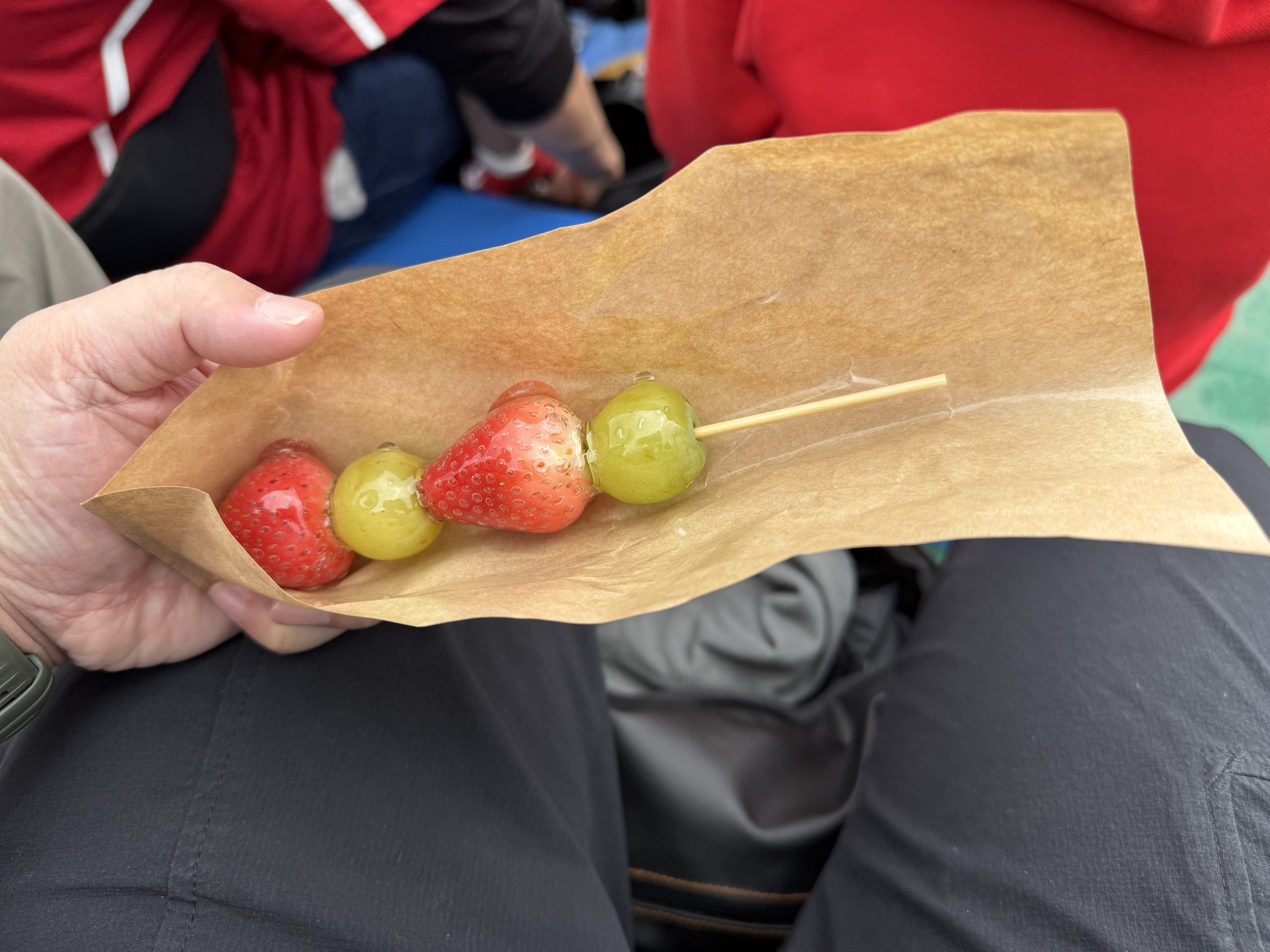
Candied strawberry and Shine Muscat mix. The crisp sugar coating and juicy fruit make it light and refreshing.
As for availability, I definitely feel like this category has grown in recent years.
If you spot one, it’s worth trying — no need to go out of your way for it.
More generally, sweets are good for a small break between sessions or as something light after a meal.
Because they aren’t too heavy, they don’t get in the way of the rest of your day.
They’re also a good option if you want to keep circuit spending under control and save more of your budget for food back at your base later.
Drinks & Alcohol | ○ Draft Beer at Permanent Stalls, △ Canned Beer at Temporary Tent Stalls
Drinks are the category where the gap between bringing your own and buying on-site is easiest to feel.
To be honest, soft drinks can be completely replaced by bringing your own, and I would recommend doing exactly that.
The harder question is alcohol.
Basically, bringing your own is still the best option, but in practical terms I think about six 350ml cans per person is the upper limit before it becomes too much to carry.
So if that isn’t enough, you end up needing to buy more on-site.
(Or maybe that’s just drinking too much.)
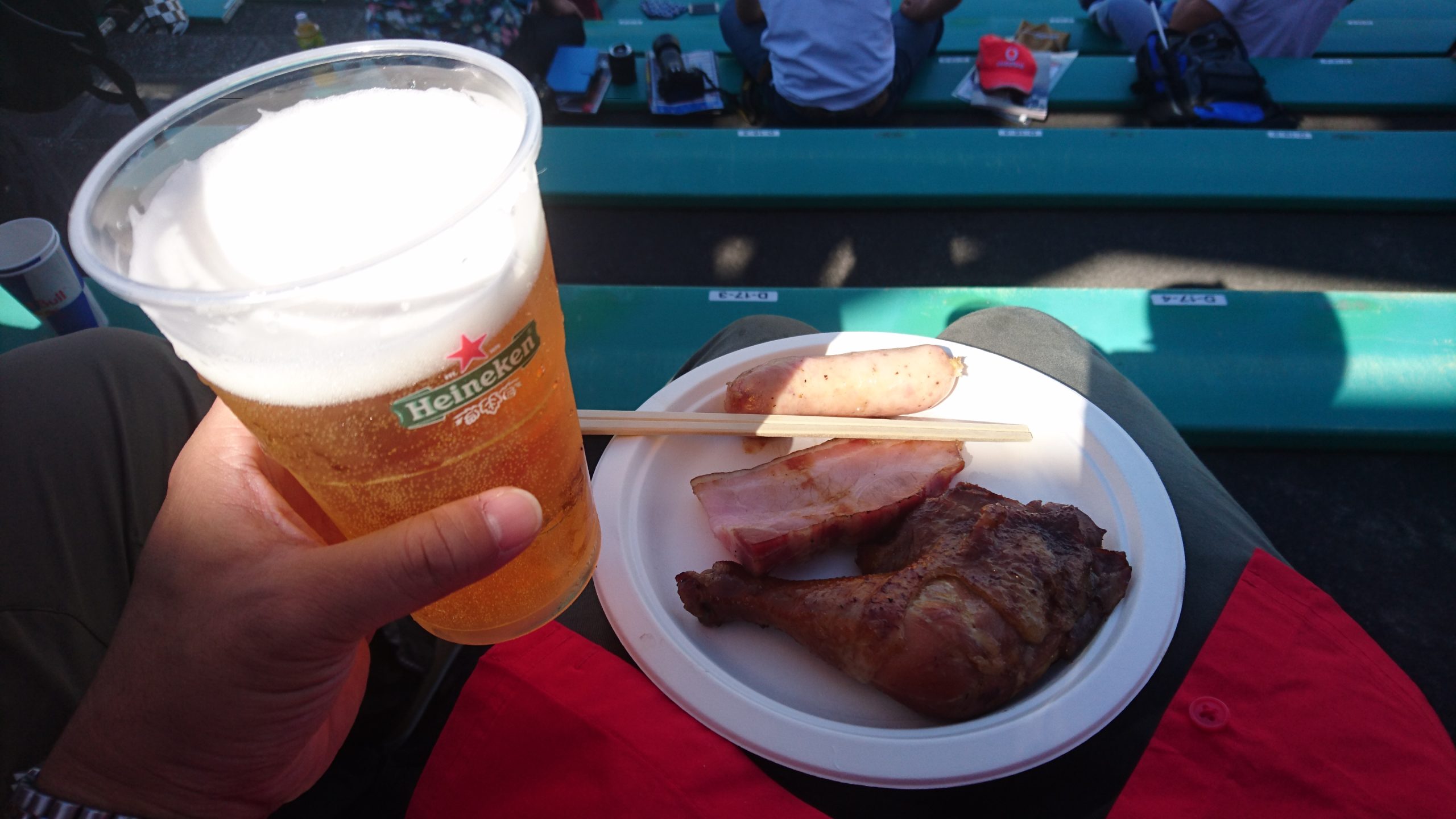
Yatsugatake smoked platter and Heineken. Why does draft beer at a circuit taste this good? Hard to explain.
○: Draft Beer at Permanent Stalls
If you’re going to buy beer on-site, draft beer from a permanent stall is the most satisfying option.
At around ¥800 to ¥1,000, it certainly isn’t cheap, but I do think drinking draft beer in the atmosphere of a racing circuit is worth paying for.
It’s the same logic as beer at a baseball stadium.
Honestly, the taste difference from canned beer isn’t that dramatic.
The ○ rating is really as much about the experience as the beer itself: drinking draft beer from a plastic cup at the circuit.
In recent F1 events, Heineken has effectively become the main beer brand on site.
You can easily find it in supermarkets these days, but somehow drinking it at Suzuka makes the whole experience feel more international.
That said, these stalls also get crowded around lunch.
It’s better to buy during the morning or while sessions are actually happening.
△: Canned Beer at Temporary Tent Stalls
For canned beer, especially during major events like F1, I would avoid temporary tent stalls if possible.
There are two main reasons: the price, and the poor operations you sometimes run into.
The price issue speaks for itself.
A 350ml can that might cost around ¥200 at a supermarket can easily be sold for nearly triple that or more.
But even more frustrating is the poor quality of the operation at some temporary stalls.
At big events like F1, some vendors seem underprepared. You can run into stalls selling beer that isn’t properly chilled, or still attracting customers even though key items are sold out and not clearly marked.
Of course, most vendors are perfectly fine, so I don’t want this to be misunderstood.
But when you do hit one of the bad ones, it can really take the edge off your day.
So for canned beer, bringing your own is still the best option.
That said, there may still be times when you really want to buy canned beer on-site.
If that happens, these are the things I would look for:
- Choose stalls that either specialize in drinks or clearly separate food and drink service windows
- Look for staff who are communicating well with each other and working smoothly
- Avoid stalls where the front counter feels unsettled or the guidance to customers seems disorganized
You can usually judge most of this before joining the queue.
The first point is especially useful, because it tells you a lot about how well the operation is being run.
How Suzuka’s Food Scene Has Changed in Recent Years
Some of this has already come up in the individual sections, but it’s worth summarising the overall picture.
These are the trends TKD has noticed over more than 15 years of eating at this circuit.
Prices have risen across the board
This isn’t unique to Suzuka, but the increase over the last few years has been noticeable.
What used to feel like a reasonable “circuit premium” has gradually crept up.
This is especially true on F1 weekends — it’s probably safest to assume a 10–20% markup on top of normal circuit pricing.
Stall turnover has accelerated
There was a time when the same vendors appeared in the same locations every year, but that is less true now.
“A stall that was there last year is gone this year” happens quite often — but on the other hand, that also means new discoveries.
If anything, it sometimes feels like the really excellent stalls disappear, while the average ones remain.
Rather than getting too attached to specific stalls, it’s better to walk around each year with a fresh perspective.
The gap between F1 and SUPER GT has widened
Attendance for both events has recovered strongly since the pandemic and is now above pre-COVID levels.
However, F1 has grown on a completely different scale, and the difference between F1 and SUPER GT weekends has become much larger.
Even at the same Suzuka Circuit, the food experience at F1 and SUPER GT should be thought of as quite different.
Sweets and light bites are increasing
Compared to the past, when heavy meals dominated, the number of sweets and light snack options has clearly increased.
It feels like the food lineup is gradually adapting to more diverse spectator styles and ways of enjoying race weekends.
Circuit Food vs. Bringing Your Own: TKD’s Conclusion
If you’ve read this far, you probably already have a sense of the answer.
So here’s TKD’s conclusion.
Circuit food is a good choice if you:
- Want to enjoy food as part of the event atmosphere
- Want to keep your luggage as light as possible
- Are visiting Suzuka for the first time and want the full circuit experience
- Are attending with friends or family and want to choose and share food together
Bringing your own food is a good choice if you:
- Want to prioritise cost performance
- Don’t want to spend time in long queues
- Don’t want to miss any on-track action
- Have specific food preferences and don’t want to compromise
TKD’s final take
Honestly, the best approach is not choosing one or the other — it’s combining both.
Bring soft drinks and canned beer with you, and then try one or two food items inside the circuit.
If you see something interesting, line up for it. If not, you still have what you brought.
This balance usually gives the best mix of satisfaction and cost control.
Suzuka’s circuit food is not something you need to “optimise” perfectly — it’s something you should enjoy.
Trying new things, sometimes succeeding and sometimes failing, is part of the experience.
That’s one of the reasons coming back to the same circuit year after year never gets boring.
Match your strategy to your own priorities, and use both inside food and outside food in a smart way.
And above all, remember that the experience of eating something you can only have at that place, on that day, is a big part of what makes it special.
With a little planning, food at Suzuka can become one of the highlights of the weekend.
Further Reading | Making the Most of Your Suzuka Visit


コメント